
How to Know If It’s Anxiety or Intuition (And why your body knows before your brain does.)
The Question That Keeps You Up at Night
You feel something.
A gut pull. A subtle alarm. A thought that won’t quiet down.
You can’t tell if it’s intuition trying to warn you — or anxiety trying to protect you.
So you analyze, spiral, seek reassurance, meditate, repeat.
But the truth is simple — and frustrating: your body registers truth and threat in the same language.
As Harvard Health explains, both anxiety and intuition activate the body’s interoceptive system the network that processes internal sensations like heart rate, gut tension, and breath. (health.harvard.edu)
That’s why both feel so real.
And why most people don’t need to “calm down” they need to decode.
1. Anxiety Speaks in Loops. Intuition Speaks in Lines.
Anxiety repeats itself.
It circles the same thought until you feel trapped in it.
Intuition arrives once — clear, quiet, and calm.
It doesn’t argue. It just is.
When you find yourself overexplaining your feeling to others (or yourself), that’s usually anxiety trying to stay in control.
Clarady’s Lens: Intuition doesn’t demand proof. It just needs space to be heard.

2. Anxiety Seeks Safety. Intuition Seeks Alignment.
Anxiety is about prevention protecting you from danger, rejection, or loss.
Intuition is about direction guiding you toward truth, even if it’s uncomfortable.
You can feel scared and still be guided.
You can feel calm and still be avoiding.
That’s why emotional intelligence matters it helps you distinguish whether your body is saying “Run” or “Reconsider.”
Anxiety Feels Urgent. Intuition Feels Immediate.
Anxiety rushes. It yells, “Do something right now!”
Intuition lands like quiet clarity — a sentence that clicks, not spirals.
One constricts your chest.
The other expands it.
As Psychology Today notes, anxiety activates the sympathetic nervous system, while intuitive knowing engages parasympathetic calm — even in uncertainty. (psychologytoday.com)
Clarady’s InnerArc™ helps you track these physiological cues how your emotional system signals danger vs. direction.
4. Anxiety Protects the Past. Intuition Points to the Future.
Anxiety is your past speaking and it’s echoing old fear, rejection, or loss.
It tries to prevent the same pain from happening again.
Intuition isn’t reactive it’s responsive.
It doesn’t need a memory to make sense. It just knows.
When your emotion feels recycled, that’s anxiety replaying a pattern.
When it feels clean, new but clear — that’s intuition leading.
5. Anxiety Asks, “What If?” Intuition Asks, “What Now?”
Anxiety time-travels. It predicts. It catastrophizes.
Intuition stays present and it doesn’t forecast, it focuses.
If the voice in your head sounds panicked or repetitive, pause.
If it sounds steady and calm even if it’s inconvenient, thats when you need to listen.
Clarady’s Innerarc™ helps you recognize this in real time. It reads your emotional signals, your timing patterns, and the context of your reactions to help you tell when fear is mimicking knowing.
The Clarady Lens: How to Tell the Difference in Real Life
Here’s a simple gut-check you can use:
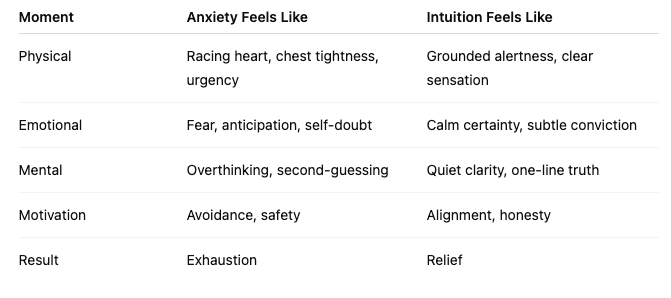
You can’t logic your way to clarity — but you can listen your way there.
So What Do You Do With the Signal?
Pause before you label it.
Don’t call it anxiety or intuition yet. Just name what it feels like in your body.Breathe until it steadies.
Wait 90 seconds — the average emotional wave passes in under two minutes if not resisted. (Frontiers in Psychology)Ask one question:
If I wasn’t afraid right now, what would I know?
That’s usually the voice of intuition waiting under the noise.
The Clarady Promise: From Reactivity to Recognition
You don’t have to silence your thoughts to trust yourself — you just have to understand them. Clarady helps you decode the difference between protection and perception.
Because anxiety guards.
Intuition guides.
And once you know which voice is speaking, you never lose yourself trying to feel safe again.
Resources & Backlinks:
Harvard Health – How Emotions Affect Your Body
https://www.health.harvard.edu/mind-and-mood/how-emotions-affect-your-bodyPsychology Today – Anxiety
https://www.psychologytoday.com/us/basics/anxietyFrontiers in Psychology – Emotional Processing and Awareness
https://www.frontiersin.org/journals/psychology/articles/10.3389/fpsyg.2020.00306/fullHelpGuide – Emotional Intelligence Toolkit
https://www.helpguide.org/articles/mental-health/emotional-intelligence-toolkit.htm
Clarity isn’t about thinking harder.
It’s about learning which part of you is speaking.
Clarady.ai helps you interpret emotion not silence it, so your intuition and intelligence can finally work together.
Join the waitlist → clarady.ai
